Pickleball Rulebook
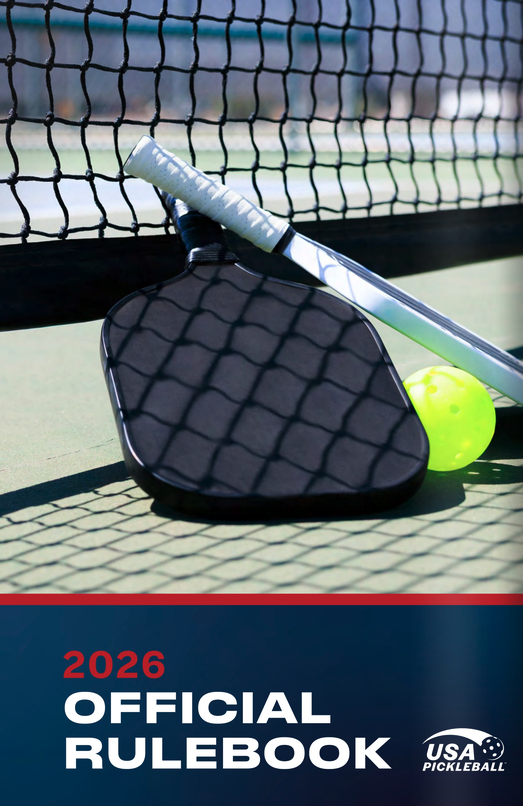
Here is the current 2026 pickleball rulebook!
Don’t forget to bookmark: USA Pickleball’s official rules page.
What Matters Most for Rec Players
Most of this year’s changes are aimed at tournaments and referees. If you mostly play open play, league, or with friends, these are the ones that will actually come up:
- Call it out fast. This is the biggest one for rec play. If you return the ball, your “out” call has to come before your opponent hits it again. Play it and then call it out later? Too late, play goes on. And if you can’t call it promptly, it’s in.
- Leave the sideline out of it. Don’t ask the folks waiting on the bench whether that ball was in. It’s now a firm “must not,” even in casual play.
- Net post bounce-ins count. If your shot lands in and then rolls or blows into the net post, it’s your opponent’s problem, not a fault on you.
- Playing rally scoring? Game point can come from either side. No more “freeze.” If you’re at game point and your opponent serves into the net, you win. Agree on this before you start so nobody’s surprised at 10–9.
- Keep your volley serve clearly legal. Without a ref, serve faults are still on the honor system, but the standard is now “clearly” below the waist, paddle head clearly below the wrist, and a clearly upward swing. If you’re living on the edge, the drop serve takes all the guesswork out.
- Wheelchair players can take two bounces. If you share courts with wheelchair players, they can let the ball bounce twice, and the second bounce can be anywhere on the playing surface. This applies in rec play too, not just tournaments.
Mostly tournament-only (safe to skip for rec): time-out signals, the visible extra ball fault, pre-match conduct penalties, and referee “too close means fault” calls on serves.
What’s New in the 2026 USA Pickleball Rulebook
- New look, new numbers. The rulebook was reorganized into a new format, so many rule numbers moved. If you have old references saved, double-check them.
- No more “freeze” in rally scoring (14.A.2). Under rally scoring, game point no longer has to be won on your own serve, so every rally can end the game.
- Out calls must be prompt (8.F.3). If you return the ball, you have to call it out before your opponent hits it or the ball goes dead. Otherwise play continues. Before, out calls could be made any time up to the next serve.
- Volley serve: “clearly” is the new standard (7.C). The word “clearly” now applies to all three volley serve requirements: contact below the waist, paddle head below the wrist, and an upward arc. In officiated matches, a too-close-to-call serve is ruled a fault rather than going to the server.
- Net post bounce-ins (10.C.5). If your shot lands in and then spins or blows into the net post, that’s no longer an automatic fault on you.
- Don’t ask the crowd (8.J). The rule about consulting spectators on line calls went from “should not” to “must not,” so asking bystanders can now lead to a warning or penalty.
- Hide that extra ball (24.B.1). In non-officiated tournament play, it’s a fault if a spare ball in your pocket is visible to your opponent or falls out during a live rally.
- Time-outs must be clear (21.A.2). In tournaments, call time-outs out loud or with a hand signal, directed to your opponents and the referee, or risk a warning.
- Conduct penalties start earlier (22.A). Penalties can now be given for behavior during pre-match briefings and warmups.
- Expanded inclusive play (Section 25). There are new and expanded rules for wheelchair, adaptive standing, and hybrid doubles. Players with significant impairments affecting balance or mobility may let the ball bounce twice before returning it. In hybrid doubles, that allowance applies only to the eligible player, not their partner.
What didn’t change: The court, the kitchen, the scoring, and the two-bounce rule are all the same.
10 Reasons to Have a Pickleball Rulebook
Here are ten reasons why having a pickleball rulebook for 2026 is essential:
- Stay current with the latest rules and updates from the governing body, ensuring accurate gameplay.
- Master the fundamentals, including scoring, court dimensions, and equipment rules, ideal for newcomers.
- Elevate your gameplay by understanding strategic nuances and making informed decisions during matches.
- Foster fair play and sportsmanship by adhering to agreed-upon guidelines and minimizing disputes.
- Resolve unclear situations promptly with official rules, maintaining smooth gameplay.
- Prepare effectively for tournaments by familiarizing yourself with specific rules and procedures.
- Provide accurate coaching and teaching, ensuring proper instruction for students.
- Utilize the rulebook as an essential tool for officiating matches and maintaining consistency.
- Organize events or leagues with confidence, following standardized rules and formats.
- Enhance your enjoyment of the game and connect with the broader pickleball community through shared understanding and participation.
Remember, always refer to the official rulebook of the governing body, such as the USA Pickleball Association (USAPA), for authoritative guidance on pickleball rules and regulations.